The dissolving of a sparingly soluble solute can be represented by an equilibrium equation:
As this is an equilibrium, we can write an equilibrium expression, called the Solubility Product:
The smaller the Solubility Product, the less soluble a solute is.
Solubility is usually expressed in one of two units: grams per litre (g L-1); or moles per litre (mol L-1).
We can use the solubility of a solute to calculate the Solubility Product, and use the the Solubility Product to calculate the solubility of a solute. Once we master these two skills, we have a good understanding of solubility.
Ionic Product is the same as Solubility Product, but when two solutions (of known concentration) are combined and the ions may form a precipitate. If Ionic Product is larger than Solubility Product, a precipitate does form. If they are equal, it is a saturated solution. If Solubility Product is larger, no precipitate will form.
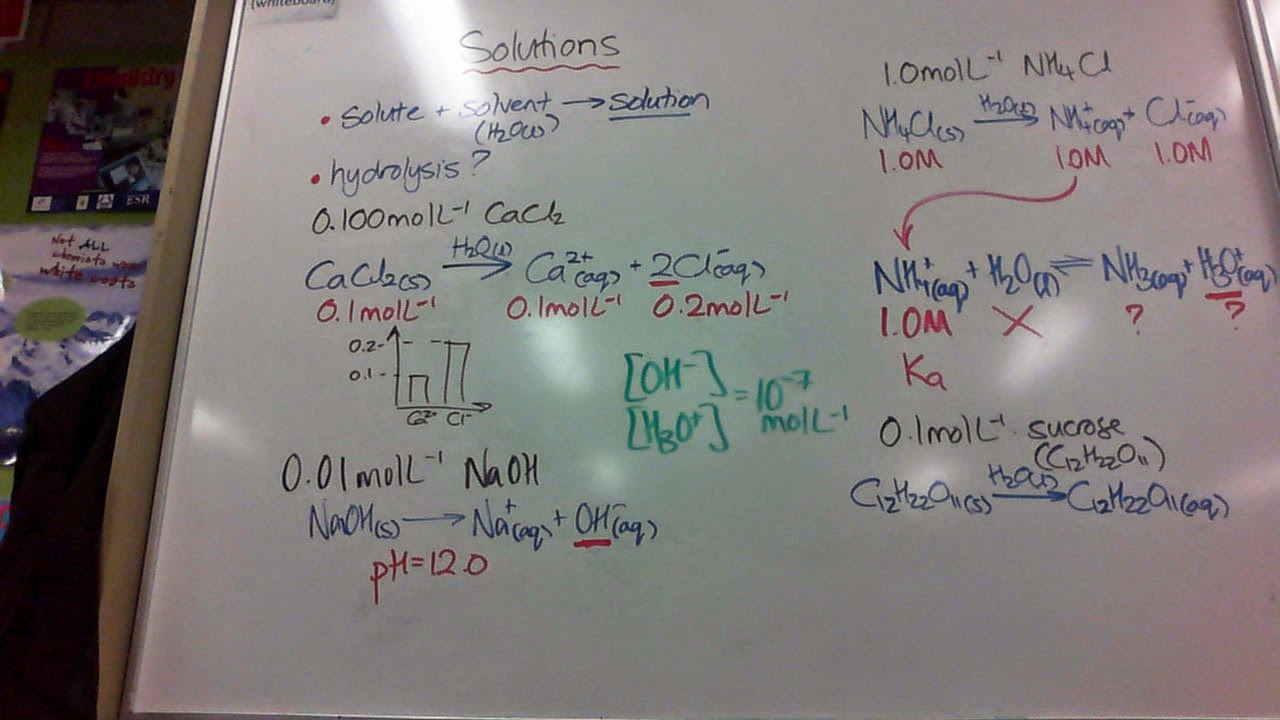
This entire unit is about things dissolved in water - aqueous solutions. If they are not dissolved in water, we do not have to consider them (too much).
The examples we need to work through by tomorrow are:
We also did a brief experiment to show why some salts are alkaliine or acidic:
We started the lesson by making an electrochemical cell using zinc chloride, a zinc electrode, copper (II) sulfate, a copper electrode. We found that this generated about 1.4V