Thursday, 28 August 2014

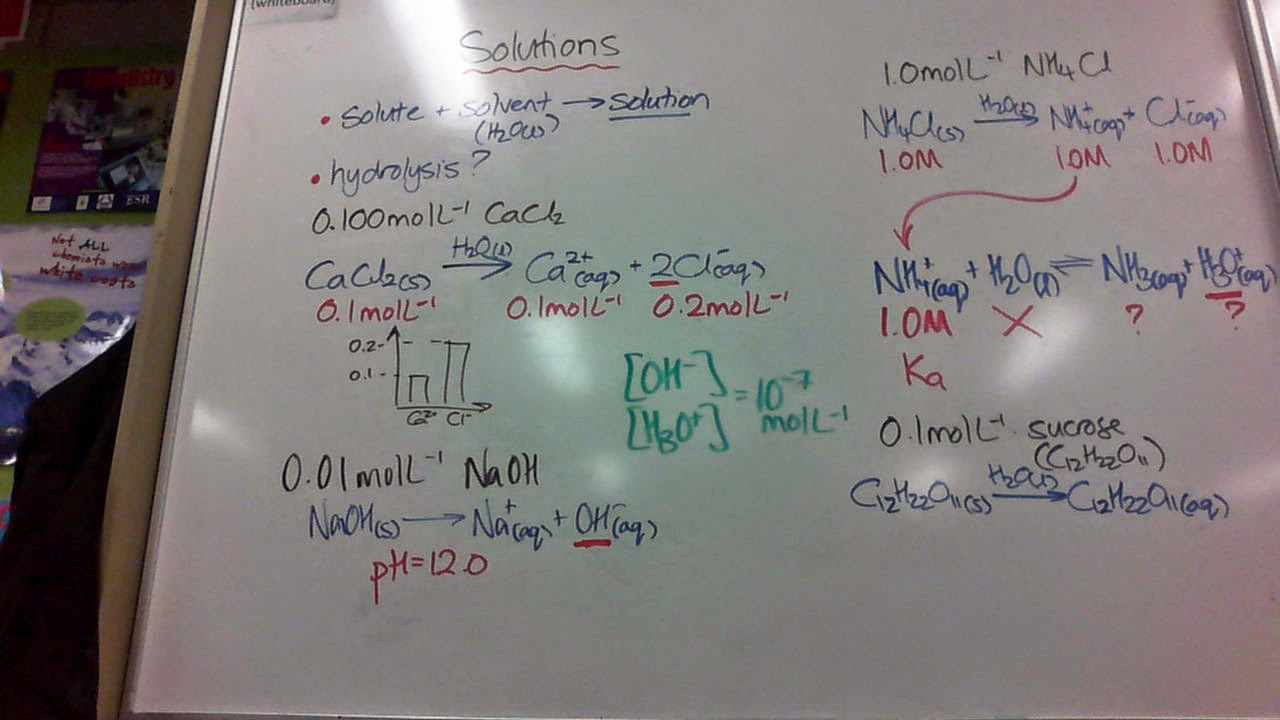
Aqueous Solutions Introduction - Species in Solution

This entire unit is about things dissolved in water - aqueous solutions. If they are not dissolved in water, we do not have to consider them (too much).


 The examples we need to work through by tomorrow are:


We also did a brief experiment to show why some salts are alkaliine or acidic:


Wednesday, 13 August 2014

Organic Chemistry Revision

We made hexagons to represent every functional group we studied in Organic Chemistry earlier in the year:


We are putting brief study notes on the back of these, and playing a few revision games with them:


Wednesday, 30 July 2014

Practical Electrochemistry

Today, we made some half-cells and combined them with a salt-bridge and a voltmeter. Then, we were asked to make sense of our observations.


Tuesday, 29 July 2014

Standard Electrode Potentials and EMF

This is a big idea and we will spend the rest of the week exploring it:

  1. What are standard electrode potentials?
  2. How are they used to find the EMF of a cell?
  3. What happens if a cell has a negative EMF?
  4. How can EMF be used to predict what would be observed in a redox reaction?
  5. How can standard electrode potentials be used to rank oxidant- and reductant-strength?


Friday, 25 July 2014

Electrochemical Cells - Introduction

We started the lesson by making an electrochemical cell using zinc chloride, a zinc electrode, copper (II) sulfate, a copper electrode. We found that this generated about 1.4V


Thursday, 24 July 2014

Electrolysis

Electricity can be used to split compounds up into their elements. This is an example of oxidation-reduction.