
Thursday, 16 October 2014
Buffers
If we think of buffers as solutions made up of weak acids and their respective conjugate bases, these are not much harder than working with weak acids. The only real difference is that we know the (desired) pH, so know the H3O+ ion concentration. Also, [H3O+] is not equal to [conjugate base] in the Ka expression.

Tuesday, 14 October 2014
Equivalence Point
This is a very tough concept to get started on, but not too tough once you work out the concentration of the salt made at the equivalence point.
This video is very long, so it may be worth having a past exam question handy and regularly using the pause button:

This video is very long, so it may be worth having a past exam question handy and regularly using the pause button:
Friday, 19 September 2014
Sketching Titration Curves
These look daunting, but it isn't actually very hard to get the general shape correct. We used a weak acid vs. strong base example:

Thursday, 18 September 2014
Titration Curves - Introduction
This was a whirlwind introduction to Titration Curves. Tomorrow, we will look at the calculations to determine the initial and final pH. Next term, we will look at how to calculate equivalence point volume and pH, and in the buffer region.

Tuesday, 16 September 2014
pH of Weak Acids
This is a very difficult concept. Every student should be able to write a hydrolysis equation, base dissociation expression (KB), and calculate KB from pKA or KA (provided in the question). Beyond that, it will take a lot of practice:


Thursday, 11 September 2014
Weak Acids
It is a bit trickier to calculate the pH of a weak acid. This is because they only partially dissociate. However, this means that these acids have an equilibrium constant (called the acid dissociation constant), which can be used to calculate the hydronium ion concentration:

The process for doing this is:
- Write the balanced equation for the dissociation with water.
- Write the acid dissociation expression.
- Substitute and solve
- [hydronium] = [conjugate base] = x
- [acid] = original concentration stated in the question (only partially dissociated)
- Calculate pH
Wednesday, 10 September 2014
Acids and Bases
This was a recap of last year. The videos are from the topic being taught to a Level 2 class.


Friday, 29 August 2014
Solubility and Solubility Product
The dissolving of a sparingly soluble solute can be represented by an equilibrium equation:

As this is an equilibrium, we can write an equilibrium expression, called the Solubility Product:

Solubility is usually expressed in one of two units: grams per litre (g L-1); or moles per litre (mol L-1).
We can use the solubility of a solute to calculate the Solubility Product, and use the the Solubility Product to calculate the solubility of a solute. Once we master these two skills, we have a good understanding of solubility.
The smaller the Solubility Product, the less soluble a solute is.
We can use the solubility of a solute to calculate the Solubility Product, and use the the Solubility Product to calculate the solubility of a solute. Once we master these two skills, we have a good understanding of solubility.
Ionic Product and The Common Ion Effect
Ionic Product is the same as Solubility Product, but when two solutions (of known concentration) are combined and the ions may form a precipitate. If Ionic Product is larger than Solubility Product, a precipitate does form. If they are equal, it is a saturated solution. If Solubility Product is larger, no precipitate will form.
Thursday, 28 August 2014
Aqueous Solutions Introduction - Species in Solution
This entire unit is about things dissolved in water - aqueous solutions. If they are not dissolved in water, we do not have to consider them (too much).
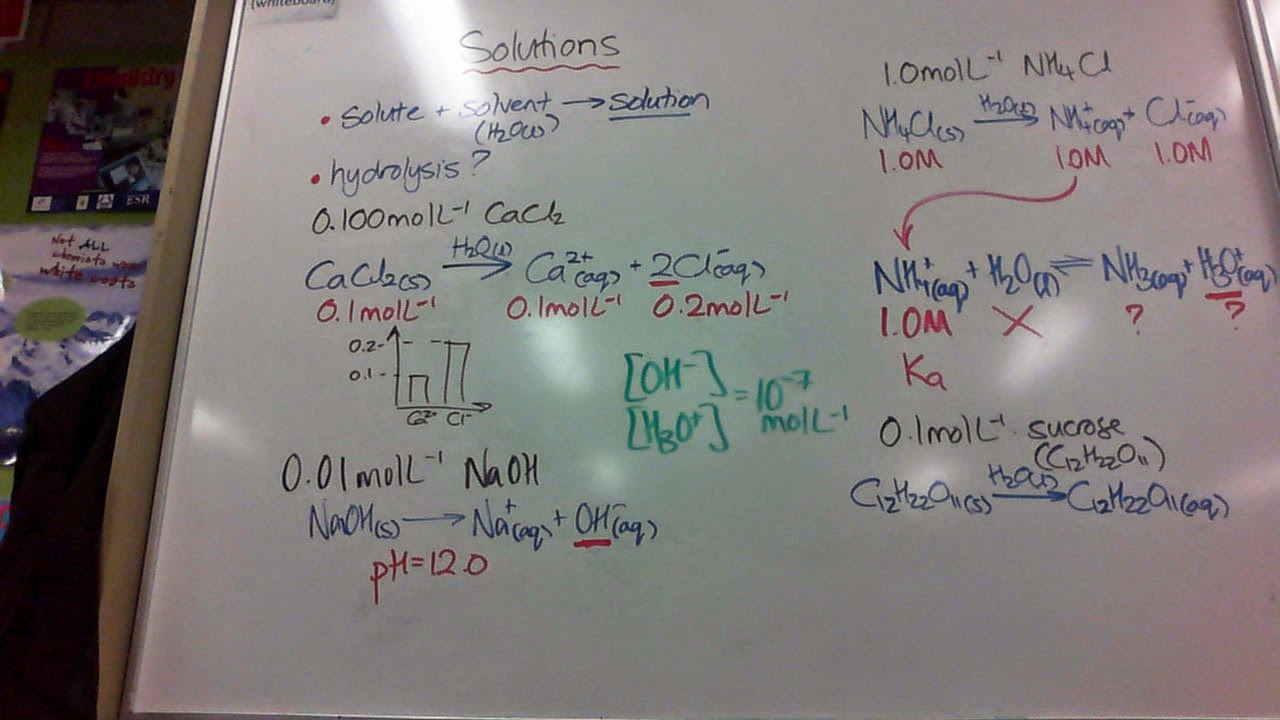
The examples we need to work through by tomorrow are:


We also did a brief experiment to show why some salts are alkaliine or acidic:
Wednesday, 13 August 2014
Organic Chemistry Revision
We made hexagons to represent every functional group we studied in Organic Chemistry earlier in the year:


We are putting brief study notes on the back of these, and playing a few revision games with them:
Wednesday, 30 July 2014
Practical Electrochemistry
Today, we made some half-cells and combined them with a salt-bridge and a voltmeter. Then, we were asked to make sense of our observations.


Tuesday, 29 July 2014
Standard Electrode Potentials and EMF
This is a big idea and we will spend the rest of the week exploring it:


- What are standard electrode potentials?
- How are they used to find the EMF of a cell?
- What happens if a cell has a negative EMF?
- How can EMF be used to predict what would be observed in a redox reaction?
- How can standard electrode potentials be used to rank oxidant- and reductant-strength?
Friday, 25 July 2014
Electrochemical Cells - Introduction
We started the lesson by making an electrochemical cell using zinc chloride, a zinc electrode, copper (II) sulfate, a copper electrode. We found that this generated about 1.4V

Thursday, 24 July 2014
Electrolysis
Electricity can be used to split compounds up into their elements. This is an example of oxidation-reduction.

Thursday, 3 July 2014

Wednesday, 2 July 2014
Balancing Redox Half Equations
Another recap of Level 2 work...


Thanks to Sam for finding these FLASH CARDS
Logan found these FLASH CARDS which are also excellent.
Tuesday, 1 July 2014
Oxidation Numbers
This is just a recap of last year's work. We discussed the allocation of oxidation numbers:

Monday, 23 June 2014
Subscribe to:
Posts (Atom)